
Leave A Message
If you are interested in our products and want to know more details,please leave a message here,we will reply you as soon as we can.

In the specialized field of chemical synthesis and industrial polymers, ethylenediamine (EDA) serves as a fundamental building block. For formulation chemists and resin manufacturers, understanding how high-purity amine diamines interact during polymer synthesis is critical to achieving superior mechanical strength, chemical resistance, and thermal performance.
At BEWELL CHEMICAL (bewellchem), we specialize in providing high-purity industrial chemical raw materials. In this article, we explore the essential chemical reactions and technical advantages that EDA offers when formulating high-performance polyamide resins.
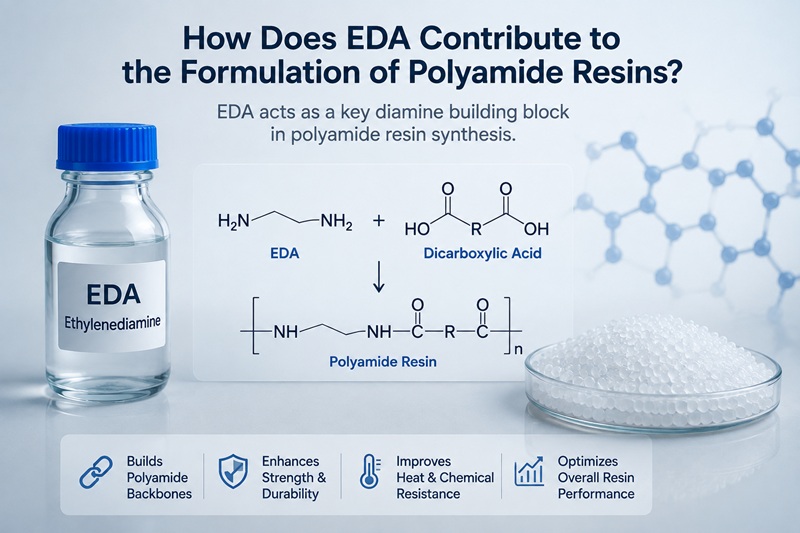
The foundation of polyamide resin synthesis lies in the polyamine condensation reaction. During this polymerisation process, ethylenediamine acts as a highly reactive difunctional amine. Its compact two-carbon aliphatic backbone terminated by two primary amine groups allows it to readily undergo condensation with polycarboxylic acids.
When reacting with long-chain dicarboxylic acids, EDA facilitates rapid chain propagation, yielding resins with precisely controlled molecular weights and tight molecular packing. The linear symmetry of EDA ensures high hydrogen-bonding density along the polymer backbone, directly contributing to the final resin's cohesive strength, tensile modulus, and structural stability.
One of the primary industrial applications for EDA is in the synthesis of reactive polyamides. By carefully balancing stoichiometry during condensation, formulators produce polyamide curing agents widely utilized in heavy-duty epoxy coatings, marine primers, and industrial floorings. These resins impart excellent flexibility, corrosion resistance, and surface adhesion to underlying substrates.
Additionally, ethylenediamine plays a key role in manufacturing non-reactive polyamide resins used extensively in hot melt adhesives. The addition of EDA into the polymer formulation lowers melt viscosity while maintaining sharp melting points and rapid green-strength development. This makes EDA-based adhesives ideal for packaging, woodworking, footwear manufacturing, and automotive assembly line applications.
In specialized resin formulations, EDA is frequently reacted with fatty acid dimers. This dimer acid reaction combines the hydrophobic, flexible aliphatic chains of dimerized fatty acids with the rigid hydrogen-bonding capabilities introduced by EDA.
The resulting dimer acid-based polyamide resins feature:
Superior Water and Chemical Resistance: Excellent barrier performance against moisture and corrosive environments.
Flexibility at Low Temperatures: Resistance to thermal cracking under severe environmental cycles.
Enhanced Substrate Adhesion: Strong bonding capability across metallic, plastic, and synthetic substrates.
The quality of your final polyamide resin depends heavily on the purity and consistency of your raw material inputs. Impurities or trace water content in amine feedstocks can disrupt stoichiometric balance, leading to incomplete polymerization, undesired color variation, or erratic viscosity levels.
As a trusted global industrial resin supplier and amine specialty provider, BEWELL CHEMICAL (bewellchem) supplies premium-grade Ethylenediamine (99.5% min purity) packed in secure steel drums and ISO tanks. Our rigorous quality control ensures that your resin formulations achieve optimal crosslinking, consistent reactivity, and uncompromised end-product performance.
To learn more about our Ethylenediamine specifications or to request technical data sheets (TDS) and samples for your resin development projects, visit bewellchem.com or contact our technical sales team directly.


leave a message
Scan to wechat :

Scan to Whatsapp :


 IPv6 network supported