
Leave A Message
If you are interested in our products and want to know more details,please leave a message here,we will reply you as soon as we can.


In modern pharmaceutical manufacturing, few excipients carry as much functional weight as Polyoxyethylated sorbitan esters. Commonly known as Polysorbates, these nonionic surfactants—particularly Tween 20 (T-20) and Tween 80 (T-80)—are indispensable across oral, parenteral, and biologic dosage forms. Their unique amphiphilic structure, derived from sorbitan esterified with fatty acids and ethoxylated, enables them to stabilize emulsions, enhance solubility, and protect delicate active ingredients.
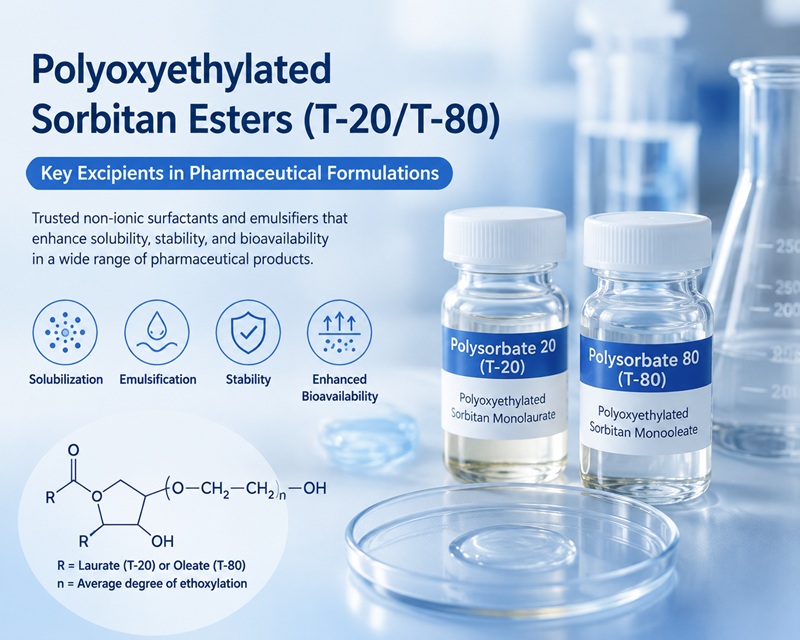
Unmatched Solubilization Power
Many drug molecules are hydrophobic and poorly bioavailable. As Solubilizers for drugs, Polysorbates form micelles that encapsulate lipophilic compounds, dramatically increasing their aqueous solubility. This property is critical for intravenous formulations, where precipitation can cause serious adverse events. T-80, with its longer oleate chain, is especially effective at solubilizing fat-soluble vitamins, steroids, and anticancer agents.
The Gold Standard in Vaccine Development
Perhaps nowhere is the impact of these excipients more visible than in Vaccine formulation. Polysorbate 80 stabilizes protein antigens and adjuvants, preventing aggregation during storage and shipping. It is a core component in numerous licensed vaccines, including influenza and COVID-19 products, where maintaining antigen integrity directly correlates with immune response efficacy. T-20, being milder, is preferred in formulations where lower irritation profiles are required.
Diverse Applications Across Dosage Forms
The breadth of Polysorbate applications extends well beyond injectables. In oral liquids and suspensions, they improve dissolution rates and mask unpleasant tastes. In topical creams and ointments, they serve as emulsifiers that deliver consistent texture and skin penetration. Even in ophthalmic solutions, carefully selected grades ensure clarity and comfort, making these surfactants among the most versatile tools in a formulator's toolkit.
Why Purity Is Non-Negotiable
Pharmaceutical excipients are not interchangeable with industrial grades. High purity emulsifiers must meet stringent pharmacopeial standards (USP/NF, EP, JP) with tightly controlled peroxide values, fatty acid profiles, and residual ethylene oxide and 1,4-dioxane levels. Impurities can trigger oxidation of active ingredients, protein denaturation, or immune reactions—particularly in biologics where even trace contaminants compromise patient safety.
Choosing the Right Grade
When selecting T-80 pharma grade, buyers should verify full compliance with current monographs, request complete Certificates of Analysis, and confirm low endotoxin and bioburden specifications for parenteral use. Reliable suppliers offer batch-to-batch consistency and transparent traceability from raw material to finished product.
Conclusion
Polyoxyethylated sorbitan esters remain foundational to pharmaceutical innovation. As Solubilizers for drugs, stabilizers in Vaccine formulation, and versatile High purity emulsifiers, T-20 and T-80 continue to enable therapies that would otherwise be impossible to deliver. For formulators and procurement teams alike, partnering with a trusted supplier of T-80 pharma grade and related Polysorbate applications is not just a purchasing decision—it is a commitment to product quality and patient safety.
At Bewellchem, we supply pharmaceutical-grade Polysorbates manufactured under strict quality controls, supporting your most demanding formulations with consistency you can rely on.


leave a message
Scan to wechat :

Scan to Whatsapp :

 IPv6 network supported