
Leave A Message
If you are interested in our products and want to know more details,please leave a message here,we will reply you as soon as we can.

In the dynamic world of cosmetic science, selecting the right ingredients is the key to creating products that are both effective and stable. Among the most versatile nonionic surfactants used today are fatty alcohol ethoxylates (AEOs). If you are formulating lotions, shampoos, or cleansers, you have likely encountered AEO-3 and AEO-9. While they share a similar chemical backbone, their behaviors in cosmetic systems are vastly different.
As a trusted chemical supplier, bewellchem is dedicated to helping formulators navigate these choices. Let’s dive into how the structural differences between these cosmetic raw materials dictate their performance, helping you choose the perfect fit for your next project.
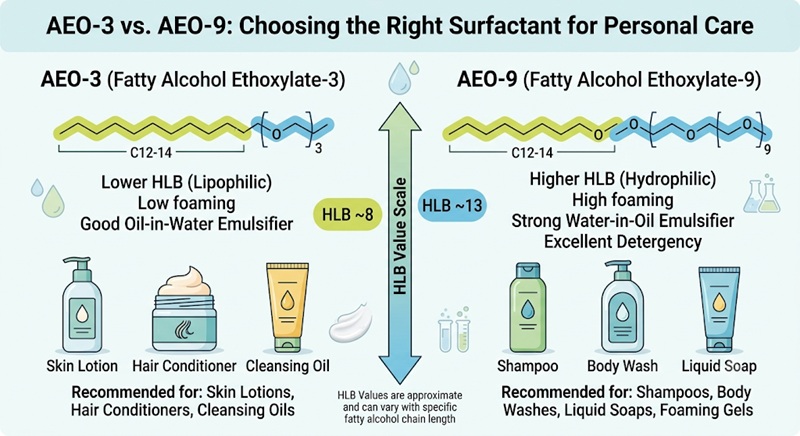
The fundamental difference between these two ingredients lies in their degree of ethoxylation. The number trailing the acronym represents the average number of alcohol ethoxylates EO moles attached to the fatty alcohol chain.
AEO-3 has an average of 3 ethylene oxide moles. With a shorter hydrophilic (water-loving) chain, it remains predominantly lipophilic (oil-loving).
AEO-9 features an average of 9 ethylene oxide moles. This longer EO chain makes the molecule highly hydrophilic and readily soluble in water.
This structural variation directly impacts how these personal care surfactants interact with water and oil phases in a formula.
When comparing AEO-3 vs AEO-9, the most critical metric for a formulator is the emulsifier HLB value(Hydrophilic-Lipophilic Balance).
AEO-3 possesses a low HLB value (typically around 8). This makes it an exceptional choice for water-in-oil (W/O) emulsions or a brilliant co-emulsifier in oil-in-water (O/W) systems. It excels at blending mineral oils and natural waxes, providing a rich, emollient texture to heavy creams and ointments.
Conversely, AEO-9 has a high HLB value (usually around 13 to 14). Because it favors water, it is widely utilized as a primary emulsifier for O/W emulsions, a wetting agent, and an excellent solubilizer for essential oils and fragrances in clear formulations.
Your choice ultimately depends on the desired end-product experience:
Choose AEO-3 if: You are formulating intense moisturizing creams, barrier repairs, hair pomades, or water-resistant sunscreens. It helps lock in moisture and provides a smooth, protective layer on the skin.
Choose AEO-9 if: You are designing body washes, facial cleansers, micellar waters, or lightweight lotions. AEO-9 offers superior foaming enhancement, excellent detergency, and ensures that your clear liquid products remain crystal clear without separation.
Choosing the right raw materials shouldn't be a guessing game. At bewellchem, we supply high-quality, consistent AEO grades tailored to meet global cosmetic standards. Whether you need the oil-soluble precision of AEO-3 or the high-clarity performance of AEO-9, we provide the technical support and reliable supply chain your business needs to innovate.
Contact bewellchem today to request samples and elevate your personal care formulations!


leave a message
Scan to wechat :

Scan to Whatsapp :


 IPv6 network supported