
Leave A Message
If you are interested in our products and want to know more details,please leave a message here,we will reply you as soon as we can.


At bewellchem, we are committed to supplying high-grade chemical raw materials that power processing innovations around the globe. Among our specialized organic intermediates, Ethylenediamine (EDA) plays a vital role in modern fabric treatment. As consumers demand vibrant, long-lasting fabrics, understanding how EDA enhances performance in the EDA textile industry is crucial for fabric chemical manufacturers and textile dye houses alike.
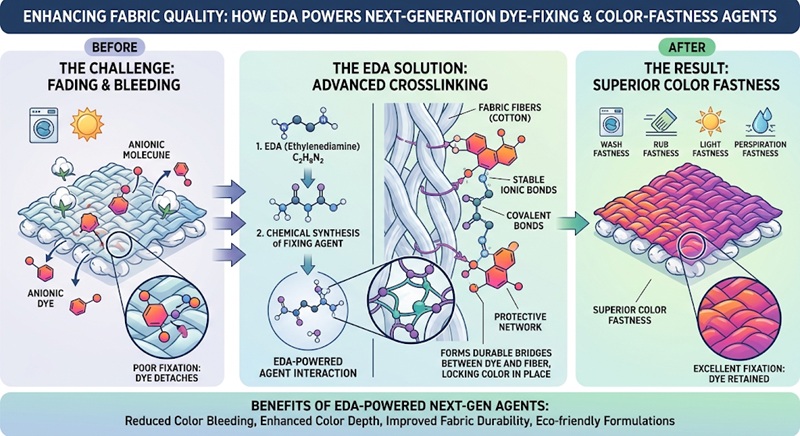
Dyeing cellulosic fibers such as cotton and rayon often presents challenges with wash fastness and wet rubbing. Unbound dye molecules can easily bleed during laundering or transfer through friction. To solve this, specialized Textile chemical formulations rely on EDA to build advanced polyamine derivatives and cross-linking networks.
1. The Core Synthesis of High-Performance Dye Fixing Agents
One of the primary applications of EDA lies in synthesizing high-efficiency Dye fixing agents. Due to its bifunctional diamine structure, EDA acts as an ideal building block when reacted with epichlorohydrin or dicyandiamide to produce resinous condensates.
These EDA-derived fixatives react with reactive or direct dyes on the fiber, forming insoluble, high-molecular-weight complexes. By locking dye molecules within the fiber matrix, these chemistry additives prevent dye migration, dramatically improving wash fastness without altering the original shade or luster of the fabric.
2. The Mechanism of Cationic Polymers in Fiber Bonding
Cellulosic fibers naturally carry a negative surface charge in aqueous baths, while anionic dyes rely on ionic attraction and hydrogen bonding to adhere. EDA is pivotal in producing quaternary Cationic polymers that modify fabric surface charges.
When applied during textile processing, these polycationic chains adsorb strongly onto the negatively charged cotton fibers. The positively charged amine sites create strong ionic bonds with the anionic dye molecules, dramatically boosting wet fastness, perspiration resistance, and resistance to chlorine bleaching.
3. Enhancing Performance in Textile Finishing Chemicals
Beyond post-dyeing fixatives, EDA derivatives serve as essential components in broad-spectrum Textile finishing chemicals. Modern eco-friendly textile processing demands formaldehyde-free or low-formaldehyde finishing solutions. EDA-based polyamines provide an effective alternative by acting as polyfunctional cross-linking agents during resin finishing.
This cross-linking not only improves color retention but also imparts anti-wrinkle properties, dimensional stability, and enhanced mechanical strength to treated fabrics, ensuring garments retain their premium quality through repeated laundering cycles.
4. Formulating Advanced Color Fastness Agents
In high-end textile processing, achieving superior rubbing fastness and wet crocking performance requires tailored Color fastness agents. Formulators utilize EDA to create custom polyamine-epoxide adducts that form flexible, protective polymeric micro-films over fiber surfaces.
This micro-film encapsulates surface dye particles, preventing physical detachment during friction while maintaining fabric softness and breathability.
Partner with bewellchem for Premium Chemical Supplies
At bewellchem, we understand that textile chemical manufacturing demands raw materials of exceptional purity and consistency. We offer stable, bulk supplies of Ethylenediamine (EDA) to empower your chemical formulations and elevate fabric performance. Partner with bewellchem today to power your production with dependable chemical raw materials.


leave a message
Scan to wechat :

Scan to Whatsapp :

 IPv6 network supported